Reading & Immersion
Can You Learn Chinese With Video Games? The Data
Yes, in part. Video games can teach you Chinese words and train your ear, but research on Chinese specifically is thin and commercial games show characters without pinyin. In Coco Chinese's November 2026 measurement, a beginner game's 722 words made up 65.5% of the running words in HSK 1 stories. Sentences come from reading.
You can learn part of your Chinese with video games: they are good at teaching words in context and at keeping you in contact with the language for hundreds of hours. They do not teach you to read characters from zero, and almost all the research behind the idea was done on learners of English, not Mandarin.
This guide covers what the studies say, what we measured ourselves, when commercial games become playable in Chinese, and what to do next to the controller at each level.
What does research say about learning Chinese with video games?
Research supports video games as a real source of second-language vocabulary, with one caveat that matters for Chinese: most of it studies English. A 2022 meta-analysis in Language Learning & Technology found a small to medium positive effect of digital games on second-language learning, and the best-known studies followed Swedish and Japanese students learning English.
Three results are worth knowing, with their limits:
- Gaming time goes with proficiency. Among 86 Swedish pupils aged 11 to 12, Sylvén and Sundqvist (2012) found that frequent gamers (five hours a week or more) outperformed moderate gamers, who outperformed non-gamers, on English tests. It is a correlation, and the authors say the strongest pupils may simply play more.
- Playing is not the same as noticing. deHaan, Reed and Kuwada (2010) paired 80 Japanese undergraduates: one played an English-language music game for 20 minutes, the other watched. Both recalled vocabulary, but the players recalled significantly less than the watchers, which the authors attribute to the mental load of playing.
- The average effect is positive. Dixon, Dixon and Jordan (2022) report an effect of d = 0.50 in between-group studies, and found entertainment games somewhat more effective than games designed for teaching, with overlapping confidence intervals.
For Chinese, the evidence is thin. In a review of 21 studies of gamified language tools, Luo (2023) counted 11 on English and 3 on Chinese. The one randomized study we found, Tang and Taguchi (2021), assigned 49 learners of Chinese at two U.S. universities to a purpose-built game or an online lesson. Both groups improved equally; the game group was more motivated. We found no peer-reviewed study of learners playing a commercial game in Chinese.
Which game should you start with if you know zero Chinese?
If you know zero Chinese, start with a game made for learners, because a commercial game set to Chinese shows characters and, as far as we could find, no pinyin. Language Game (made by a team we work with closely) is built for exactly this stage: absolute beginners, first words.
Language Game is a pixel-art adventure game that runs in the browser on a computer, phone or tablet, with 16 languages to learn. In Chinese, you explore a small Chinese town, scan objects to get their name written as a character with its pinyin and spoken aloud, then win the words in duels. The full game teaches 722 everyday words in 32 themes across 7 islands, plus first sentences and short grammar lessons.
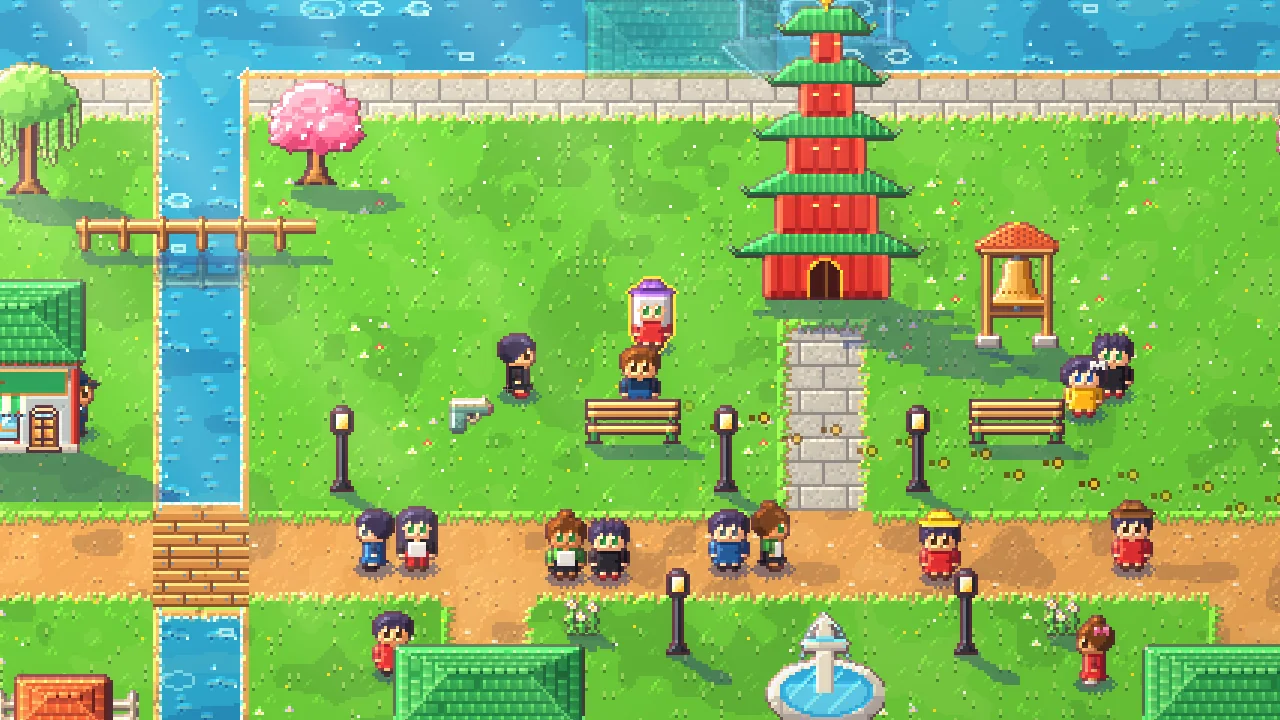
It is free to start: the first island costs nothing, and the full game is a single payment with no subscription. Its ceiling is clear too. It is for absolute beginners only, and it will not take you to reading a page of Chinese.
Play Language Game free in your browser
How far do a beginner game’s words take you in real Chinese?
A beginner game’s words take you about two thirds of the way through a beginner text, and no further. In our November 2026 comparison of Language Game’s 722 words with the 25 HSK 1 stories in Coco Chinese, 192 of the words appeared at least once, and they made up 65.5% of all the words on the page.
We call this measurement the Language Game x Coco Chinese word overlap, November 2026. It covers the 94 stories of Coco’s curriculum: 25 each at HSK 1, HSK 2 and HSK 3, and 19 at HSK 4.
| Level | Words | Game words | Share |
|---|---|---|---|
| HSK 1 | 2,351 | 192 (27%) | 65.5% |
| HSK 2 | 4,248 | 253 (35%) | 50.6% |
| HSK 3 | 6,861 | 313 (43%) | 41.6% |
| HSK 4 | 7,987 | 350 (48%) | 37.4% |
| All | 21,447 | 455 (63%) | n/a |
“Words” is the running words of the stories, “game words” is how many of the 722 appear at least once, and “share” is the part of the running words that are game words. Method: the stories are split into words in our database and each game word is compared with those words. Punctuation and proper nouns are excluded, the share of the text counts repetitions, and the script is tools/language_game_overlap.py.
Two readings follow. First, 65.5% is high because Chinese words do not change form, and the game teaches the small frequent ones: 我 (wǒ, I), 说 (shuō, to say), 很 (hěn, very), 的 (de), 在 (zài, at). Second, 65.5% is far from enough. Studies of English reading put the minimum for adequate comprehension at about 95% of words known and the comfortable level at about 98% (Laufer and Ravenhorst-Kalovski, 2010; Hu and Nation, 2000). One word in three is still missing in the easiest stories, and the share falls to 37.4% at HSK 4.
What is missing is the glue. The most frequent HSK 1 story word that the game does not teach is the particle 了 (le), and 吗 (ma), 都 (dōu, all), 呢 (ne) and the measure word 个 (gè) are all in the top ten. In the other direction, 267 game words never appear in the 94 stories: 23 of the 25 fruits and vegetables, like 香蕉 (xiāngjiāo, banana), and 18 of the 23 farm words, like 兔子 (tùzi, rabbit). A game names things. Stories show how sentences hold together.
When can you play commercial games like Genshin Impact in Chinese?
Commercial games become useful in Chinese once you can read short lines of characters without pinyin, which for most learners means somewhere around HSK 3 to 4; that is our estimate, not a measured threshold. We found no pinyin display documented for any of the games below, so plan on bare characters.
| Game | What is in Chinese | How the language is set |
|---|---|---|
| Genshin Impact | Chinese voice-over, one of four voice languages, plus Chinese text | In the settings: voice-over language and text language are separate |
| Black Myth: Wukong | Simplified Chinese interface, full audio and subtitles | Steam: Properties, then the Language tab |
| Stardew Valley | Simplified Chinese text (Steam lists no full audio) | Steam: Properties, then the Language tab |
| Animal Crossing: New Horizons | Simplified and Traditional Chinese text | Follows the Nintendo Switch system language |
| Pokémon Scarlet and Violet | Simplified and Traditional Chinese text | Chosen when you start a save, cannot be changed later |
Sources: the Steam page of Black Myth: Wukong, Steam Support, Nintendo’s Animal Crossing page and Nintendo Support, checked on 29 November 2026.
Three practical notes. Animal Crossing characters speak Animalese, a synthesized made-up language, so the game is reading practice only. Black Myth: Wukong is made by a Chinese studio and based on Journey to the West, a Ming dynasty novel, so do not expect HSK vocabulary. And voice and text are separate in Genshin Impact: Chinese voices with text in your language is a gentle first step.
What should you do at each level?
At each level, the game is the fun part and something else does the teaching: pinyin and tones at zero, graded reading from HSK 1, native content later. The stages below are our recommendation, built on the measurements above.
| Your level | Game time | What does the teaching |
|---|---|---|
| Zero | A learner game with pinyin and audio, such as Language Game | Pinyin and tones from day one |
| HSK 1 to 2 | A game you know by heart, set to Chinese, in short sessions | A graded story a day with audio |
| HSK 3 to 4 | Chinese voices, then Chinese text; look up words that come back | Graded stories, then manhua and C-dramas |
| HSK 5 and up | Story-heavy games fully in Chinese | Native reading and listening |
Keep the deHaan result in mind while you play: your attention goes to the game first. Pause on a line, read it aloud, and write down the words that keep coming back.
Where Coco fits
Coco Chinese is the step after the game: graded stories with native Beijing audio, tap-to-translate pinyin and spaced repetition, which is where the 了 and 个 of real sentences get learned. If you have finished Language Game, read the free HSK 1 stories next: about two words in three will be words you have met, and the rest come in context. The method behind it is explained in our guide to comprehensible input for Chinese, and Coco Chinese carries it from HSK 1 upward.
The bottom line
Video games can teach you Chinese words and keep you listening, and studies on English learners back that up. For Chinese, the research is thin and commercial games give no pinyin. A beginner game’s 722 words cover 65.5% of an HSK 1 story, so use a learner game at zero, read graded stories to reach sentences, and switch your favourite games to Chinese from about HSK 3.
Frequently asked questions
Can you become fluent in Chinese just by playing video games?
What is the best video game to learn Chinese as a complete beginner?
Can you play Genshin Impact in Chinese to learn Mandarin?
Do video games in Chinese show pinyin above the characters?
How do you switch a game to Chinese on Steam or Nintendo Switch?
What HSK level do you need to play video games in Chinese?
Learn Chinese with real stories
Coco teaches Mandarin through graded, illustrated stories with native Beijing audio, tap-to-translate pinyin and smart spaced repetition. HSK 1 to 6.
Start learning free